
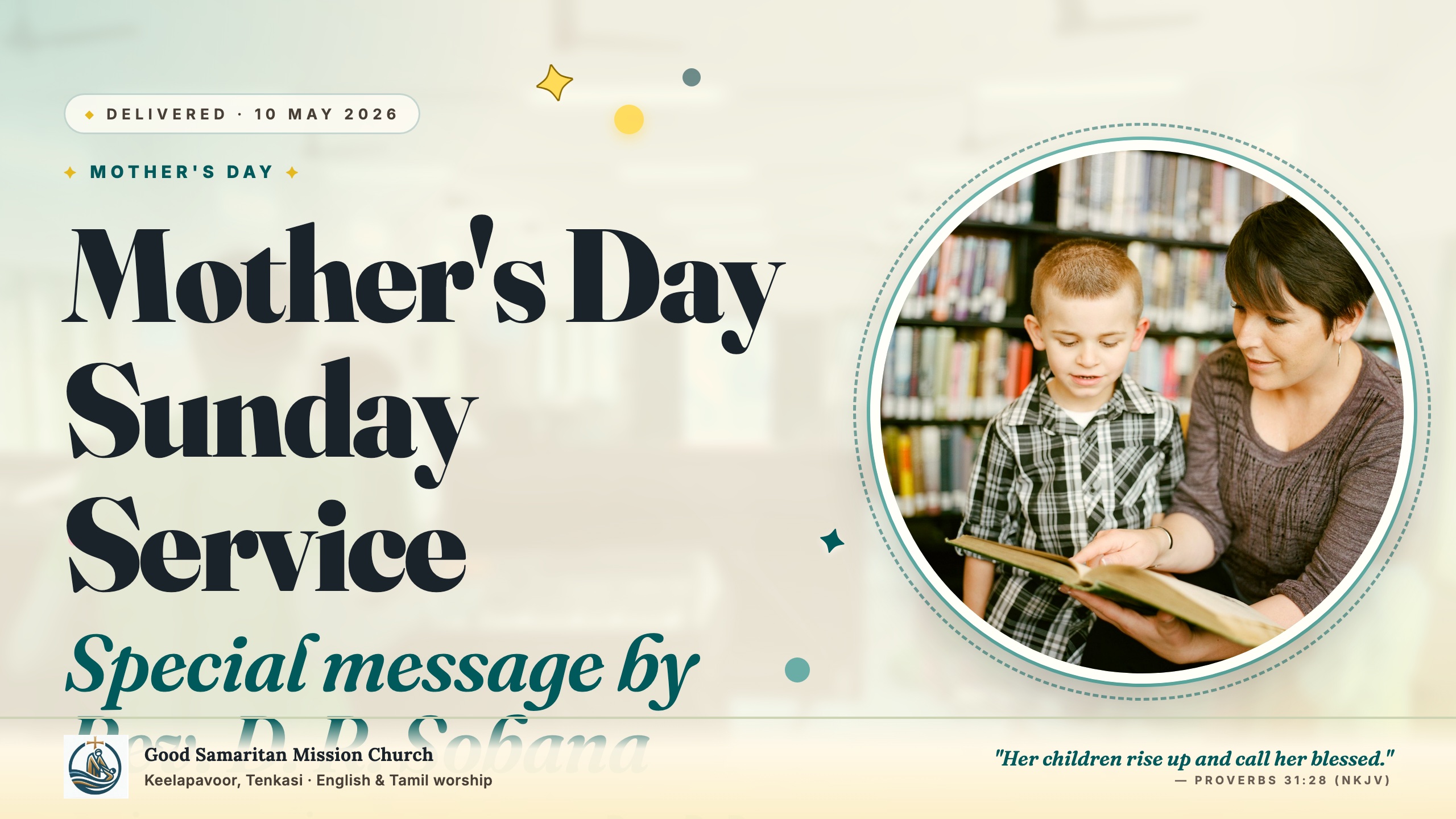
Mother's Day Sunday Service - தாய்மை நாள் ஆராதனை
தாய்மை நாள் ஆராதனை
A mother is a child's first window onto the world and onto God. Rev. D. R. Sobana opens Proverbs 31 and 2 Timothy 1 to show how unfeigned faith is handed from grandmother to mother to child, how children must honour the mother who bore them, and how the church herself is called to be a mother to the town.
ஒரு தாய் தான் ஒரு பிள்ளைக்கு உலகத்தையும், தேவனையும் முதல் முதலில் காட்டுகிறவள். நீதிமொழிகள் 31 மற்றும் 2 தீமோத்தேயு 1-ஐ அடிப்படையாக கொண்டு, மாயமற்ற விசுவாசம் பாட்டியிடம் இருந்து தாய்க்கும், தாயிடம் இருந்து பிள்ளைகளுக்கும் கடத்தப்பட வேண்டியதையும், பிள்ளைகள் தாயை எவ்வாறு கனம் பண்ண வேண்டும் என்பதையும், சபையே இந்த ஊருக்கு தாயாக எழும்ப வேண்டியதையும் Rev. D. R. Sobana அம்மா விளக்குகிறார்.
Psalm 113:9, Proverbs 31:14-31, Proverbs 31:28, 2 Timothy 1:1-9, 2 Timothy 3:15, 1 Timothy 5:5, 1 Timothy 5:14, 1 Timothy 6:12, Psalm 146:9, Psalm 127:4, Proverbs 13:24, Proverbs 23:22, Exodus 2:9, Genesis 27, Daniel 3, 1 Thessalonians 5:14, Hebrews 10:25
A Mother Introduces You to the Lord (ஒரு தாய் ஆண்டவரை அறிமுகப்படுத்துகிறாள்)
On Mother's Day the pulpit belongs, fittingly, to a mother. The pastor opened by recalling 2 Timothy 1 - the verse where Paul reminds Timothy that the same faith which lived in his grandmother Lois and his mother Eunice now lives in him. No one likes every single thing about their parents; no one likes every single thing about anyone. There will always be some point of difference. But there is one debt the pastor refuses to leave unpaid: his mother is the one who led him to the Lord.
"I am reminded of the genuine faith that is in you, which dwelt first in your grandmother Lois and your mother Eunice, and I am persuaded is in you also." - 2 Timothy 1:5 (NKJV)
"உனக்குள்ள மாயமற்ற விசுவாசத்தை நினைவுகூருகிறேன்; அது முந்தி உன் பாட்டியாகிய லோவிசாளுக்குள்ளும் உன் தாயாகிய ஐனிக்கேயாளுக்குள்ளும் நிலைத்திருந்தது; அது உனக்குள்ளும் நிலைத்திருக்கிறதென்று நிச்சயித்திருக்கிறேன்." - 2 தீமோத்தேயு 1:5 (TAOVBSI)
A grandmother and a mother carry a weighty responsibility: to carry faith - her faith in Christ - into the next generation. Elsewhere Paul tells Timothy, "From childhood you have known the Holy Scriptures" (2 Timothy 3:15). Who taught him those Scriptures from childhood? His mother. A child's first teacher is not the schoolteacher. A child's first teacher is the mother. The father's influence comes later, as the child grows. But in those earliest years - for the first ten years or so - it is the mother who shows the child what the world is, who interprets the world for the child, whose words and ways become the child's first scripture.
The pastor put it plainly: "My mother led me to the Lord. She led me when I was very young. There were many years afterwards when I wandered far from the Lord. But the reason I stand today doing the Lord's ministry - the Lord is the ultimate cause of everything, but in this world the first human cause is my mother. If she had not introduced me to the Lord, I would never have come this far." Every mother carries that same possibility for her own children.
So mothers are urged: bring your children up in the way they should go. "He who spares his rod hates his son" (Proverbs 13:24). If the fear of God is not planted in a child while they are small, they will not fear anyone or anything when they are grown. Teach them the Word now. Whether they are your own children or other children who come near you, do not let them leave without something of Scripture spoken into their lives.
A Word of Thanksgiving (நன்றியின் வார்த்தை)
Before opening the text, Rev. Sobana paused for testimony - because seventy years of life behind her could not pass without thanksgiving. Tomorrow she turns seventy. Many people have wondered about her age over the years; some ask directly, some go around the back and ask others. But just yesterday a young girl named Nandhini said to her, "Patti, patti, I was looking for you. I didn't find you. Only when you came out of this house did I realise you are the owner of this house. Why do they call you patti (grandmother)? It never occurred to me. I would call you Aunty." She receives that gladly. She does not think about her own age. Let others think about it; she does not.
Her driver too once told of an old acquaintance from her banking days who asked, "How is amma? Is she still active?" - and he answered, "She is exactly as she was when she worked in the bank." The reason for all of this, she said, is one thing only: the Holy Spirit lives within us. Through these seventy years the Lord has led her, and for that her thanksgiving belongs to her God, கோடான கோடி ஸ்தோத்திரம் (countless thanks).
She named the people who stood with her along the way:
- The congregation who walked with her through ministry and through family troubles, strengthening her, loving her.
- Beula, whose memory she will never lose - in days when ₹10 was a large sum, during her frequent forty-day fasts, Beula would send a brimful brass pot of buttermilk through her brother-in-law at precisely 2 PM each day, refusing payment.
- Brother Kingston, who stood beside her at the police station the day a complaint was filed against her by a child from the church. He was her companion that day.
- Rajathi amma, who went and spoke to the inspector that same day, vouching that "this woman is not at all that kind of person - we know her" - and saw to it that no action was taken on the complaint.
- Sheela, who once carried the Sunday School and VBS work faithfully, going for training and bringing back what she learned. She is missed; the pastor's grief was that Sheela has stopped coming. "Do not forsake the assembling of ourselves together," Scripture says (Hebrews 10:25).
- Her parents, whom she has never once seen quarrel - not raised voices, not arguments, not bitter words. There were differences in the family, of course, differences of opinion between them, but never shouting. Her mother would rise at 4 AM and as she worked she would sing - Pamalai hymns, English hymns, all morning long. The sound of those 4 AM hymns is still in the pastor's ears, and that is how her own love for hymns was born. Her parents' compassion for the poor, their hospitality to ministers, their kindness - all of it was watched and absorbed in childhood.
- Her one brother and his family, who came today, for whom she is deeply grateful.
- Her own children, whom the Lord has guided in answer to long years of prayer.
"Her children rise up and call her blessed; her husband also, and he praises her." - Proverbs 31:28 (NKJV)
"அவள் பிள்ளைகள் எழும்பி அவளைப் பாக்கியவதி என்கிறார்கள்; அவள் புருஷனும் எழும்பி அவளைப் புகழுகிறான்." - நீதிமொழிகள் 31:28 (TAOVBSI)
The Bible Is a Book for the Whole of Life (வேதம் வாழ்க்கை முழுவதற்கும் கொடுக்கப்பட்ட புத்தகம்)
Before turning to Proverbs 31, the pastor paused on a misconception. Many people think the Bible is only for Christians. Even among Christians, many think it is only for pastors, or for those who pray well, or for the educated. None of this is true. The Bible is a book about how a human being should live, how a human being can be blessed. It is, in a sense, even a book of medicine - every kind of need has its answer here.
She told the wartime story she returns to often: during the Second World War, scientists in England were transporting bombs that must not detonate in transit. As they took counsel together, one of them found a verse in the book of Job and from it learned to pack the explosives in ice, which is how the cargo was carried safely. Even how to wage war can be found in this book. Politics is here. How to run a family is here. From the moment a person is born until they die - and beyond death, into the world to come, how we are to enter it and how we are to live there - all of it can be learned from this book.
Therefore the Bible must be read with attention. It is the Word of God. And the Lord Jesus Christ has another name: the Word of God. What we are holding in our hands is not an ordinary book, not a religious book of a single tradition; it is the Word of the God who made everything. To hold the Bible is, in a sense, to hold Christ Himself. So treat it accordingly.
She told the story of a soldier shot in the chest during battle. The enemy left him for dead. His comrades carried his body quickly back to camp - and there they discovered he was not dead. The bullet had not reached his heart. In his breast pocket he had always carried a New Testament, and the bullet had lodged in its pages. "The Word of the Lord is your protection," she said. "Honour this book. Lift it up. Read it. Live by it."
What a Mother Is Like - Proverbs 31 (ஒரு தாய் எப்படிப்பட்டவள் - நீதிமொழிகள் 31)
The pastor remarked, with quiet humour, that her son had already preached half this sermon for her - meaning Pastor Praveen's earlier teaching on Proverbs 31:28. She picked up the thread there. While a mother lives, no one is an orphan. As long as a mother is with us, however old we may be, we are never orphaned. "How many of you still remember your mother? Every one of us, however old, remembers her. I do - every morning when I rise, I thank God for giving me a good mother and a good father."
The witness of a mother's life comes first from her children. From the moment the child opens its eyes, the mother is everything to that child. Up to about twelve years, what mother says is scripture to the child. The mother shows the child the world. So when Proverbs 31 says her children rise up and call her blessed, that blessing is the verdict of those who watched her most closely.
Her Hands and Her Words (அவளுடைய உழைப்பும் வாயும்)
Read the verses immediately before verse 28 and you find a portrait of labour and wisdom:
- She seeks wool and flax and works willingly with her hands.
- She is like the merchant ships, bringing her food from afar.
- She rises while it is yet night and gives food to her household.
- She sets her hand to the spindle.
- She makes coverings of tapestry; she clothes her household.
- "She opens her mouth with wisdom, and on her tongue is the law of kindness" (Proverbs 31:26).
From her lips no foul word is heard. She does not gossip about other houses. She does not run down the neighbours. She does not speak arrogantly to her husband. She does not curse him with ugly words. Children are watching all of this. They are watching how a mother is in the home. A child will only honour the father if the mother first honours him. Think honestly: are you raising your children that way?
Her Hand to the Poor (சிறுமையானவர்களுக்கு அவளுடைய கை)
"She extends her hand to the poor, yes, she reaches out her hands to the needy." - Proverbs 31:20 (NKJV)
"சிறுமையானவர்களுக்குத் தன் கையைத் திறந்து, எளியவர்களுக்குத் தன் கரங்களை நீட்டுகிறாள்." - நீதிமொழிகள் 31:20 (TAOVBSI)
Generosity, the pastor said, is learned from one's mother. She learned it from her own mother, who learned it from her mother. Her grandmother kept cows, and when neighbours came needing milk for a child, however much they wanted was given free - no money taken. That habit travelled down through her mother into her, and from her into her own children. Virtue does not appear by itself; it has to come from the mother. The mother has to teach it.
She told of her two sons when they were small. One day a noise came from outside, and one of them - Praveen - went to look. He came back saying, "Amma, a பிச்சைக்காரன் (beggar) has come." Immediately the other one, Naveen, corrected his brother: "Don't say 'beggar.' Say a பிச்சைக்காரர் (sir who begs) has come." The pastor was deeply proud. The children had been watching. They had absorbed the dignity their mother extended to others, and they were already extending it themselves. "If we respect others, our children will love to respect others."
A Woman Who Saves (சேமிக்கிற பெண்)
"She considers a field and buys it; from her profits she plants a vineyard." - Proverbs 31:16 (NKJV)
"ஒரு வயலை விசாரித்து அதை வாங்குகிறாள்; தன் கைகளின் சம்பாத்தியத்தினால் திராட்சத்தோட்டத்தை நாட்டுகிறாள்." - நீதிமொழிகள் 31:16 (TAOVBSI)
This mother saves. The pastor named a present-day danger: the self-help chit-fund groups (குழு) into which many women have plunged their families, sinking into debts they cannot climb out of. Before any expense, she said, think a thousand times. Is this necessary? Buying from here, buying from there, taking loans - at some point the lock snaps shut, and the whole family is in crisis.
The Proverbs 31 woman saves so that tomorrow's lack will not crush her household. The pastor's counsel was concrete: as a tenth of your income belongs to the Lord, so a tenth of your income must without fail go into savings.
Her Eye on the House (வீட்டு காரியத்தின் மேல் கண்ணோக்கம்)
"She watches over the ways of her household, and does not eat the bread of idleness." - Proverbs 31:27 (NKJV)
"அவள் சோம்பலின் அப்பத்தைப் புசியாமல், தன் வீட்டின் காரியம் எப்படி நடக்கிறது என்று கண்ணோக்கமாயிருக்கிறாள்." - நீதிமொழிகள் 31:27 (TAOVBSI)
To "watch over" the house is to know what is happening with the children, with the husband, with the rhythms of the home. Today many mothers, the pastor warned, take no real interest in their children. The child whimpers; a mobile phone is handed over with a film playing on it. Little by little the child starts watching other films. By the time you want to correct it, you cannot. Mothers must know where the child is going, where the child is coming from, with whom the child is speaking. "Today many mothers let it all slide. 'That's her brother, that's her friend, that's his classmate' - and they pay no attention to where the children go or what they say." You work hard for the children - but if the children are ruined, what was all that work for? Not a single thing.
"Behold, children are a heritage from the Lord, the fruit of the womb is a reward." - Psalm 127:3 (NKJV - pastor referenced as Psalm 127:4)
"இதோ, பிள்ளைகள் கர்த்தரால் வரும் சுதந்தரம்; கர்ப்பத்தின் கனி அவரால் கிடைக்கும் பலன்." - சங்கீதம் 127:3 (TAOVBSI)
Children are a gift. Would you hand a precious gift over to just anyone? No mother would. Whatever the cost, I will raise this child myself. We have seen so many mothers in this very congregation who have borne unbelievable hardship and refused to hand their children over. Their eyes are on those children. But the eyes are not enough. Mind and heart must be on the child too - கண்ணும் கருத்துமாக.
The Rod Belongs in the House (வீட்டில் பிரம்பு வேண்டும்)
"He who spares his rod hates his son, but he who loves him disciplines him promptly." - Proverbs 13:24 (NKJV)
"பிரம்பைக் கையாடாதவன் தன் மகனைப் பகைக்கிறான்; அவன்மேல் அன்பாயிருக்கிறவனோ அவனை ஏற்கனவே சிட்சிக்கிறான்." - நீதிமொழிகள் 13:24 (TAOVBSI)
Discipline is not the hand - it is the rod. The pastor was emphatic: every house must have a rod. This is not her opinion; this is Scripture. Foolishness is bound up in the heart of a child; the rod drives it far from him. In America, she said, children cannot be disciplined this way - strike a child and a great offence is recorded; the child can simply call the police. And what has America become? Filled with every kind of sin. At ten years old, children go anywhere with anyone. At twelve and thirteen they are roaming with boys, with girls, anywhere. At fourteen, children are pregnant. Is that the society we want? Then discipline must begin early.
But the rod is not for venting anger. If you are angry with your husband, do not bring that anger down on the child. If you are irritated with someone else, do not strike the child with it. The rod is for correction, for teaching what is good - that and nothing else. When a mother disciplines, she is not hating; she is loving. "My brother got far fewer beatings than I did," the pastor laughed. "He stayed home; I ran around the village. One whole day I dragged him along and lost him - they searched the wells, the canals, the river, and found him at last asleep under a peepal tree in a threshing yard. They brought him home and I got the beating. To this day I remember every blow my mother gave me. It hurt then. But today I thank her every single day for every blow."
She added, with regret: "While my mother was alive, I should have said these things to her. I should have told her, 'Amma, thank you.' I grieve over that even now." Children: understand that when a mother corrects you, it is love.
And mothers - do not spoil children by giving in to every demand. Make them feel your hardship. Before buying anything, explain: Is this truly necessary? This costs this much. To earn this much I had to work this many hours. What else could this money do? Teach them. That is raising a child.
Without Partiality (பாரபட்சம் இல்லாமல்)
Treat your children without favouritism. The pastor pointed to Genesis 27. Isaac had two sons. Esau was always out hunting. Jacob stayed by his mother in the kitchen, helping her, dear to her. When the time came for the father's blessing, Rebekah played favourites - she overheard, she planned, she taught Jacob exactly how to deceive Isaac, and Jacob stole the blessing meant for Esau.
What was the result? Enmity between Esau and Jacob. And did that enmity end when Esau and Jacob died? Not at all. It is still going on today. The wars between Israel and the surrounding nations - at their root is this brotherly feud begun in one mother's partiality. And when nations fight, we ourselves are affected: fuel prices rise, gas grows scarce, everything is touched. So: do not show partiality among your children. Do not stir up division among them.
Unfeigned Faith - 2 Timothy 1 (மாயமற்ற விசுவாசம் - 2 தீமோத்தேயு 1)
Paul writes that the faith in Timothy came first through his grandmother and then through his mother. Paul watched and noticed - and what Paul wrote about it is striking. It is a மாயமற்ற விசுவாசம் - unfeigned, sincere, undeceiving faith. Not a faith that changes with circumstances. Not a faith that prays in trouble and runs from God when trouble passes. Not a Bible that is opened in crisis and gathers dust the rest of the year.
Many today raise children in just that way. When there's a need, they pray. The rest of the time they run from the Lord. When there's a need, they read the Bible. Otherwise it sits in a corner gathering dust. They will not think of the Lord. They wander. They speak filthy words. They come home worn out and dirty. But if you have unfeigned faith yourselves, that faith will pass into your children. The measure of your faith is the measure of your children's faith.
The pastor named a particular danger in our churches. People who in the early days suffered, prayed in tears, were sustained by the church, who took part in every ministry regularly - once a comfortable life arrives, they stop coming. "We live in the world now, our work is bigger, our family connections are bigger." That faith is not unfeigned faith. There may be belief, but it is not the faith that brings us to heaven. The faith that gets you earthly goods is not the faith that saves. Raise your children for the Lord - only that is unfeigned faith.
Raise Them for the One Who Gave Them (தந்தவருக்காகவே வளர்க்கணும்)
"Take this child away and nurse him for me, and I will give you your wages." - Exodus 2:9 (NKJV)
"நீ இந்தப் பிள்ளையை எடுத்துக்கொண்டு போய் எனக்காக அதை வளர்த்திடு; நான் உனக்குச் சம்பளம் கொடுப்பேன் என்றாள்." - யாத்திராகமம் 2:9 (TAOVBSI)
Pharaoh's daughter drew Moses out of the water and gave him back - unknowingly - to his own mother, saying, Raise this child for me. The mother who took him knew the child was destined for the palace. So she had to raise him fit for the palace, ready for the day the queen would call him back.
In just the same way, God hands children into mothers' hands and says, Raise this child for me. Today we feed our children Boost and Horlicks and every supplement, and we plan their bodies. We arrange every ornament for the girls. We push them to study - twenty-two hours out of twenty-four - to become doctors, engineers, lawyers, IAS officers, collectors. Every parent has such dreams. "But whatever else you teach your children or do not teach them, after death there is a life. Prepare them for that - only then is everything else worth anything."
Have you said that to your children at home? Be careful. Death can come any day. After death there is a life. Heaven or hell? The decision is ours. God is not the one who decides - God has shown the way. We decide. My conduct, my faith, my unfeigned faith - that is the decision. Have you taught your children this? Have you given it priority? Think about it.
The pastor was equally pointed about Sunday worship. Many people no longer come to church. Paul writes, "Do not forsake the assembling of yourselves together" (Hebrews 10:25). Was Paul a fool? He was a great minister; he met every kind of opposition; and he writes that we must not forsake the assembling. People today imagine they can search the Scriptures privately and that there is no necessity to come to church - "I can sit at home and pray, and at the Lord's coming He will find me sitting at home." No: every word of Scripture is to be read, honoured, and obeyed.
Zeal for the Lord (பக்தி வைராக்கியம்)
"You shall not learn the way of the Gentiles." - Jeremiah 10:2, paraphrased (NKJV)
"நீங்கள் புறஜாதியாருடைய மார்க்கத்தைக் கற்றுக்கொள்ளாதிருங்கள்." - எரேமியா 10:2 (TAOVBSI)
Raise your children in zeal for the Lord. Do not let them learn the ways of the surrounding religions. Do not let an idol mean anything to them. Do not let them serve idols, nor join with anything bound to them. Many mothers today raise children who say casually, "You go to your temple festival; I'll go to your Christmas." That is wrong.
She set before us Shadrach, Meshach and Abednego. The king demanded they fall before the image. Their answer: our God is able to deliver us - and even if He does not, we will not bow. The king grew furious, heated the furnace seven times more, and threw them in. And they did not burn. The God who delivers came down into the fire with them and brought them out. When the king called them out, not a hair was singed, not a thread of their clothes was burnt, not even the smell of smoke was on them. That is zeal for the Lord. That is what we must build into our children.
She told the story of a recent visit. A widowed sister from another church, raising two girls - one in tenth, one in ninth - had placed the elder in a convent hostel in a nearby town because of her own hardship. The girl refused to stay. Why? Because once a week the hostel made her dust and touch the statues - Mary, Anthony, Gabriel, all of them - and worship them. "I won't, Amma. I won't stay." The mother begged her to bear it for one year. The girl said, "Amma, until yesterday you told me one man was my father. Today you tell me to call another one father. How can I?" That child had zeal. She was right.
But what did the mother do? In that village it is customary to throw a great ceremony for the re-piercing of the ears of girls - a "ear-piercing festival," with invitations and gifts. She decided to hold this ceremony for both her girls. She did not ask the pastor - she knew what the pastor would say. She asked another sir, who told her, "We don't do these things; leave it alone." She went ahead anyway. The invitation came on WhatsApp: a beautiful Bible verse on top, and below it the line "Jesus, Mary, Joseph - be our help." This from an anointed woman, a woman who speaks in tongues, a saved woman, whom the pastor had once asked to lead worship in her absence. The pastor preached against it openly the previous week - not naming anyone, but naming the wrong. "In our village Christians simply do not do this. Even the Hindus today do not hold an 'ear-piercing festival' - they go to a temple, pierce the ears, share a meal at a hotel for ten people, and come home. It has become a pitiful livelihood." When the elder daughter heard the pastor's message, she turned to her mother and said, "Didn't I tell you?"
Search the Bible: was there ever an "ear-piercing festival"? Ears were pierced - for slaves. In Scripture, when a man's ear was pierced, it was the mark of a slave. There was no festival, no ceremony. Did girls not exist in those days? Think about it. Do not learn the ways of the nations. Teach the children otherwise.
The Good Fight of Faith (விசுவாசத்தின் நல்ல போராட்டம்)
"Fight the good fight of faith." - 1 Timothy 6:12 (NKJV)
"விசுவாசத்தின் நல்ல போராட்டத்தைப் போராடு." - 1 தீமோத்தேயு 6:12 (TAOVBSI)
Teach your children to fight the good fight from when they are small. The world is a frightening world. There will be many problems to face, many battles, many wounds, many humiliations. Today how many people end their lives, broken in heart - whole families, even. If you do not teach a child the fight of faith now, when they grow up they will not be able to face any battle at all. Their minds will break and they will look for the same dark exits.
How do you teach this? Not by locking the child in the house, not by saying do not talk to anyone. The opposite: let them mingle freely with the whole church. You must be the one who pushes them out to meet others. Only then will they discover what is good and what is bad. Only then will they see - I thought my problem was the biggest, but my neighbour's was a hundred times worse - and only then will they begin to take courage.
The pastor's own testimony: "There is no humiliation I have not faced. There is no battle I have not faced. There are no tears I have not shed. But all of it I poured out in the presence of God. I do not cry before people. If you look at my old Bible, the tear-stains are still on its pages - I have kept that Bible carefully." That faith does not appear suddenly at twenty when the first big trouble comes. It is grown in the small years. The world is broken. There is no peace in it. But if the Lord is with you, you will be at peace.
She remembered one of the hardest seasons of ministry: going to a new village where she knew no one, no family, no one at all. The whole village gathered, the women came in a mob in front of the house where she was staying and screamed at her, abused her, cursed her with foul words. "In ministry," she said, "I have no thin skin. If I had thin skin I could not do ministry. Even if they spit on you, wipe it off and go back to them and speak kindly. Children, knowing nothing, will do hurtful things. We feel angry. But we must not let go of them. Whatever the child is like, we must not let go. As far as you can, chasten your son - Scripture says so. As far as we can - do not abandon any child."
The Widow, the Single Mother (கைம்பெண்களும் தனிமையான தாய்மார்களும்)
"The Lord watches over the strangers; He relieves the fatherless and widow." - Psalm 146:9 (NKJV)
"கர்த்தர் பரதேசிகளைக் காப்பாற்றுகிறார்; திக்கற்ற பிள்ளையையும் விதவையையும் ஆதரிக்கிறார்." - சங்கீதம் 146:9 (TAOVBSI)
Whether anyone else sees us or not, the Lord supports. In whatever situation, the Lord supports. And His support is not only food - it is peace, the lifting of anxieties, the gift of joy.
"Now she who is really a widow, and left alone, trusts in God and continues in supplications and prayers night and day." - 1 Timothy 5:5 (NKJV)
"உத்தம விதவையாயிருந்து, தனித்து விடப்பட்டிருக்கிறவள் தேவன்மேல் நம்பிக்கையுள்ளவளாயிருந்து, இரவும் பகலும் வேண்டுதல்களிலும் ஜெபங்களிலும் நிலைத்திருப்பாள்." - 1 தீமோத்தேயு 5:5 (TAOVBSI)
Older widows have time - much time. Use it in supplications and prayers. Pray for the family, for the children, for the ministry, for ministers, for the salvation of relatives. So many relatives today are walking towards hell without knowing Jesus, without knowing salvation. Pray for them.
For young widows Paul writes differently:
"I desire that the younger widows marry, bear children, manage the house, give no opportunity to the adversary to speak reproachfully." - 1 Timothy 5:14 (NKJV)
"இளவயதுள்ள விதவைகள் விவாகம்பண்ணவும், பிள்ளைகளைப் பெறவும், வீட்டை நடத்தவும், விரோதியானவன் நிந்திக்கிறதற்கு ஏதுவானதொன்றையும் செய்யாதிருக்கவும் வேண்டும்." - 1 தீமோத்தேயு 5:14 (TAOVBSI)
These are evil times, and wrong relationships are easily formed. Mothers, when there is a young widow in the family or the church, give her counsel.
And single mothers - those who raise children alone - carry deep mental anguish. They have walked through trouble like a mother's trouble multiplied. Pray for them. Counsel them. Embrace them. Bring them the counsel they need from Scripture.
Children: How to Honour Your Mother (பிள்ளைகளே, தாயை எப்படி கனம் பண்ணுவது)
The pastor turned the sermon now to the children. "What will you do for your mother? What gift will you give?" - and answered from Scripture.
"Listen to your father who begot you, and do not despise your mother when she is old." - Proverbs 23:22 (NKJV)
"உன்னைப் பெற்ற தகப்பனுக்குச் செவிகொடு; உன் தாய் வயதுசென்றவளானபோது அவளை அற்பமாயெண்ணாதே." - நீதிமொழிகள் 23:22 (TAOVBSI)
You do not know the pain a mother bore. She gave birth in agony; in giving you life she nearly died. Then her son grows up and says - "What do you know? What do you understand? This whole family's ruin is because of you." That happens in many homes. That is why disobedience is everywhere - talking down to a parent, "avaa, ivaa" (a contemptuous she, he), "What do you have to ask me?" The grown child imagines they have become bigger than their mother. But Scripture says: do not despise her when she is old.
As you grow older, your mother grows older too. What do mothers wait for? Not for a son to come and pile crores at her feet. Children, do you really think your mothers are waiting for that? Tell the truth. What mother wants money brought in by the bundle? None. A mother's one longing is this: that my child would sit beside me for ten minutes and ask - Amma, did you eat? Amma, did you drink water? Are you well? Yesterday you said your body wasn't right; how are you today? Shall I bring you a tablet? That is what a mother wants. Nothing else.
The pastor named her own brother with great pride. "He cared for our mother like a daughter cares. He cared for our parents so beautifully. When my mother was in the ICU she would look around for me. I had ministry; I couldn't always come. The day I did get leave and reached her bedside, the moment she saw me peer in, lying there in the ICU, she would say, 'Ah, my daughter has come,' - and she would sit up. But who actually looked after her, all of it, every day? My brother. Every blessing of that care has gone to him."
She put the question directly: How many of you sit and talk with your mother daily - even ten or fifteen minutes? Raise your hands. Daughters-in-law also - how many of you ask after your mother-in-law? "Today both my daughters-in-law call me 'amma.' That is my pride. Their first question is, 'Did you eat?' Then, 'How are you?' The doctor one will ask, 'Amma, did you take your eye drops? Did you do this, did you do that?' The other one will ask, 'Did you eat?' - and the moment she's here food is in front of me." Children, do not be dismissive.
Today we tell ourselves: I am educated. My mother only studied till fifth class. I did an MA. So who is bigger? But experience teaches wisdom, and your mother has more experience than you do. "My mother is just lying there. She's a fool. She's mad." The pastor named that talk plainly: "You will receive no blessing. I am telling you."
So children: be careful. When you speak about your mother, when you speak to your mother, begin with respectful address - வாங்க, போங்க (the respectful "come," "go," in Tamil, used to elders). The first time after years of careless speech it will feel awkward. Do it anyway. Get used to it.
Sit with her. Understand her hardships. Where is this money coming from? How much are you spending? "Amma, you spend so much on me - it must be hard." Her elder son once told her, when he was only in seventh or eighth standard, in those terrible days when his father was drinking heavily: "Amma, believe me. In my whole life I will not touch drink. I will not use any drug. I will not smoke a cigarette." A small boy, saying that. And to this day he has been faithful to that word. Raise your children this way. Children, you must give your mother that assurance. "Amma, don't worry about me. I will be well. I will live with discipline. I will not do wrong."
And love her openly. "Give your mother a kiss - how happy she would be. Nothing in the world is more precious than that. In India we are too shy to kiss; in Europe and America they will embrace their mothers and kiss them - have you seen it? Watch the good things, not only the bad."
One more warning. The respect you give your mother will be the respect society gives her. If you say "avaa, ivaa" about her in the street, the neighbour will say "avaa, ivaa" too. If you curse her, the neighbour will curse her too. And by the time you realise it, you cannot run out and pick a fight with the neighbour - because you taught the neighbour to speak that way. So mothers, be careful. Children, be careful.
The Church Is a Mother (சபை ஒரு தாய்)
A church is also a mother. Just as a mother conceives, nurtures, and forms a child, a church planted in a town is a mother to that town. You - each one of you - are a mother to this town.
What does a mother do? She gives birth. How does a church give birth? By weeping over the town in prayer, by sharing the gospel, by calling people in. The pastor asked the congregation: have we ever forced anyone? Have we ever made a single person change their religion? Many of you came from Hindu backgrounds - you heard, you came on your own, you stayed. Did anyone of us pay you money to convert? People in the wider world say that - "Give me a lakh rupees and I will become a Christian. With one lakh I could pay off a debt." Money does not change anyone. Just as a voter takes money from four or five parties and still votes for whoever they wanted to vote for, no one becomes a Christian for cash. Only the Word of the Lord changes a person. No pastor can change you. No son of a pastor can change you. The Holy Spirit working through the Word changes you.
So bring them in. Bring the children in. Bring the young people in. Tell them: come and see, come and hear. We will not force you; we will not dunk you in water and pull you out. That is not our work. The work is the Lord's.
"Now we exhort you, brethren, warn those who are unruly, comfort the fainthearted, uphold the weak, be patient with all." - 1 Thessalonians 5:14 (NKJV)
"அன்றியும், சகோதரரே, ஒழுங்கில்லாதவர்களுக்கு புத்திசொல்லுங்கள், திடனற்றவர்களைத் தேற்றுங்கள், பலவீனரைத் தாங்குங்கள், எல்லாரிடத்திலும் நீடிய சாந்தமாயிருங்கள் என்று உங்களுக்குப் புத்திசொல்லுகிறோம்." - 1 தெசலோனிக்கேயர் 5:14 (TAOVBSI)
A mother-church must do exactly this. Warn the disorderly. Comfort the fainthearted. Uphold the weak. Be patient with all. Patience means: do not let them go. Do not give up on anyone. Do not say, "It's finished, I can do nothing for them." With the help of the Holy Spirit, again and again and again, be ready to bear with them.
Every person in this town has been given into your hands. The Lord will ask. "I placed you in this town," He will say. Today the pastor herself has come from Madurai to be here; each one of you has come from one village or another to be planted in Keelapavoor. The Lord did not bring you here without a reason. He has placed His trust in you. "I have brought this child here - she will be a mother to this place. I have brought this man here - he will be a father to this place." That is why this church is here.
So from today onward, take part eagerly in the ministry of the church. Do not draw back on any pretext. You are not doing this for Pastor Praveen, not for any one of us - you are doing it for the Lord. He has placed all these people in your hands. Tomorrow He will ask the account. He has placed your own family in your hands. Tomorrow He will ask: "Did you raise them for Me?" You will not be able to answer, "I don't know - that's Praveen's job." The church, being a mother, must labour to bring many into salvation.
Prayer (ஜெபம்)
Let us turn over what we have learned. The Lord has given us beautiful children as a gift, a கிஃப்ட், a token of His love placed into our hands. Whatever kind of child He has given you, you are the one who must take responsibility for that child.
Let us pray: Lord, help me to raise my children rightly - in Christ, in faith, fighting the good fight. Help me, Father. And children, pray: I will support my mother. I will love my mother. I will honour my mother.
Good Father, thank You. Thank You, God of the Spirit, that You have spoken to us. For our children, Lord - at each age and in each season, help us to do what each age requires. Help us not to forsake our children, but to seek their good. At every stage, in every matter, supply what each child needs, so that they may grow and multiply and fill this earth, and that we mothers may lead them in You. Let us not be a stumbling block to them. Guard us, Lord. And for this whole town - Lord, we are mothers to it. Let this church rise up as a mother and bring many into You. We humble ourselves and pray, in the name of Jesus, good Father. Amen.
Keep reading
Scroll through the full sermon to mark it as read.
Reflect on This Sermon
- 1.What is one thing from this sermon that spoke to you personally?
- 2.How can you apply this message in your daily life this week?
- 3.Is there a verse from this sermon you want to memorize?