
 உன் தேவனா, என் தேவனா? (Whose God?), Part 4 of 4
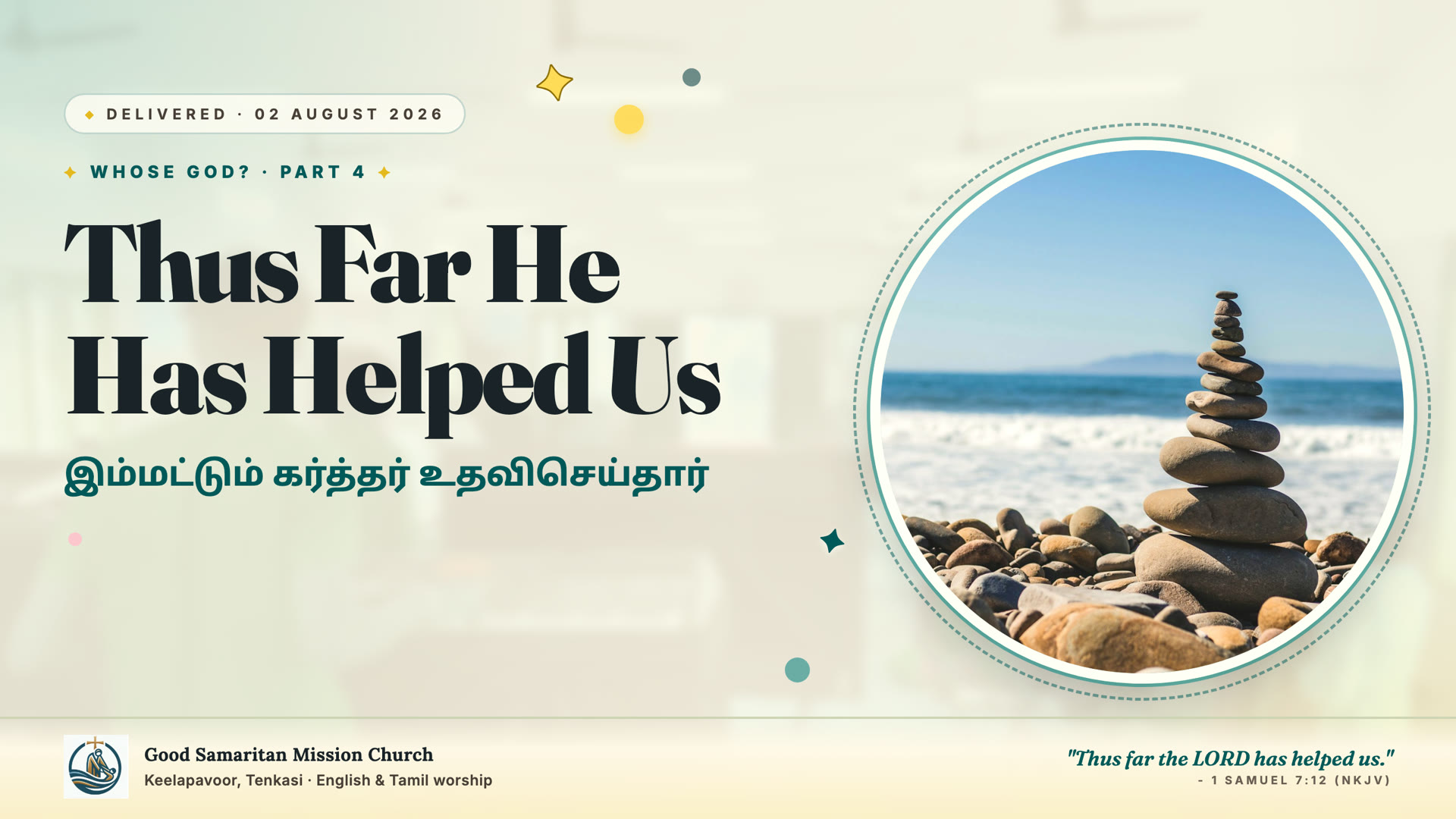
Thus Far He Has Helped Us
இம்மட்டும் கர்த்தர் உதவிசெய்தார்
After twenty years of drifting, Israel repents together at Mizpah, and God thunders for a people who had nothing in their hands but a cry. The stone Samuel raises says 'thus far the LORD has helped US' - and the series ends where it must, with 'my God' becoming 'our God' at one Table.
இருபது வருஷ அலைச்சலுக்குப் பிறகு இஸ்ரவேல் மிஸ்பாவிலே ஒன்றாய் மனந்திரும்புகிறது; கையிலே ஒரு கூக்குரலைத் தவிர ஒன்றுமில்லாத ஜனத்துக்காக தேவன் வானத்திலிருந்து முழங்குகிறார். சாமுவேல் நிறுத்தின கல் சொல்லுகிறது - 'இம்மட்டும் கர்த்தர் எங்களுக்கு உதவிசெய்தார்.' இந்தத் தொடர் முடிய வேண்டிய இடத்திலேயே முடிகிறது: 'என் தேவன்' ஒரே பந்தியிலே 'நம்முடைய தேவன்' ஆகிறார்.
1 Samuel 7:3-12, 1 Samuel 7:3, 1 Samuel 7:9, 1 Samuel 7:12, 1 Corinthians 11:23-29, 1 Corinthians 11:28, Psalm 1:3, Jeremiah 17:8, Daniel 3:17-18, Matthew 6:24, John 10:10, John 6:44, Matthew 9:38, Psalm 37:21
For four Sundays we have been asking one question out of the books of Samuel: உன் தேவனா, என் தேவனா? Whose God is He? We began with Saul, who kept the rules and still kept a distance - always "your God," never once "my God." Then we watched Israel fetch the ark like a talisman, wanting the power of "THE God" (அந்த தேவன்) while refusing any personal walk with Him. Last week we stood with David at Ziklag and learned to strengthen ourselves in "my God" (என் தேவன்) at the very bottom. Today the series ends where a series like this should end - not alone with "my God," but together, as one people, with நம்முடைய தேவன் - our God. After twenty years of drifting, Samuel gathers the whole nation at Mizpah, and they do the one thing Saul never did: they repent together. And it is fitting that this final word fell on a Communion Sunday, because the stone Samuel raises gathers a whole congregation into one testimony (ஒரே சாட்சி).
"Then Samuel took a stone... and called its name Ebenezer, saying, Thus far the LORD has helped us." - 1 Samuel 7:12 (NKJV)
"அப்பொழுது சாமுவேல் ஒரு கல்லை எடுத்து, மிஸ்பாவுக்கும் சேணுக்கும் நடுவாக நிறுத்தி, இம்மட்டும் கர்த்தர் எங்களுக்கு உதவிசெய்தார் என்று சொல்லி, அதற்கு எபெனேசர் என்று பேரிட்டான்." - 1 சாமுவேல் 7:12 (TAOVBSI)
From My God to Our God · என் தேவனிலிருந்து நம்முடைய தேவனுக்கு
Before we come to Mizpah, take stock of the road so far. The person who says "your God" keeps a little distance from Him - a distance carefully maintained. The person who says "THE God" - the one who talks about Him as a power somewhere up there who will look after everything - accepts His strength but wants no personal relationship with Him. Between those two, where have we placed the Lord? Is He our father's God? A good God we speak well of from far away? Or have we made Him our own - என்னுடைய தேவன், my God?
Here is the test of that ownership. When hands went up that morning for "He is my God," a second question followed: of you who raised your hands, how many are carrying heavy money needs - and of those, how many are running for them in your own strength? If I truly believe He is my God, can He not meet my need? A wedding to conduct for the children, fees to pay when parents cannot earn, a house, a job - the pressure of a need is real, and thoughts will crowd in. But the one who says "my God" does not sit down inside the worry. The God who made heaven and earth is my God - what more do I need beyond that? That confidence quietly settles problem after problem. Should I take this step or not? Speak to this person or not? Be in this place at this hour or not? The Lord arranges it all for the one who holds "my God" as the standing truth of his life. And sometimes, in the middle of the running, He speaks into the heart: you are running on your own strength - slow down. When He says slow down, we slow down. Run while you can run; if tomorrow you cannot run, the Lord will look after it. Sit today worrying about tomorrow, and today is wasted along with it.
The devil works the opposite way. He brings the war news into your mind, the gas price, the lockdown rumour. There was such a talk once - lockdown is coming, that is the end, fill your petrol tanks, petrol will vanish. Some filled the tank and then rode a bicycle to protect it. To this day petrol has been available. People who live inside that fear do not yet hold the trust called "my God." The days are hard days; the season is a dark season; the rains do fail. But the one who keeps relationship with தேவன் is like the tree the church had looked at just the day before - a tree that grows two ways, upward where everyone can see and downward where no one can, roots gripping their way toward the watercourse, so that even when the rains fail it gives its fruit in season without missing (Psalm 1:3, Jeremiah 17:8). The growth below the ground is the part that decides everything above it.
That is "my God." Personal faith. But personal faith is the beginning, not the end. This morning's word is about the next step - how "my God" becomes "our God."
What Happens in 1 Samuel 7 · 1 சாமுவேல் 7-ல் நடந்தது
Samuel calls Israel to put away their foreign gods and return to the LORD with all their heart (முழு இருதயத்தோடு). They gather at Mizpah (மிஸ்பா), draw water and pour it out before the LORD, fast the whole day, and confess together: "we have sinned."
The Philistines hear that all Israel is assembled in one place and march up to attack. In the very hour of worship Israel stands defenceless - no swords, no spears, nothing in their hands but a cry. Samuel offers a suckling lamb and cries out to the LORD, and the LORD thunders from heaven (வானத்திலிருந்து முழங்கி) with a great thunder upon the Philistines, throws them into confusion, and they are beaten down before Israel. Israel only has to pursue a victory தேவன் has already won.
Then Samuel sets up a stone between Mizpah and Shen and names it Ebenezer (எபெனேசர்) - "stone of help" - saying, "Thus far the LORD has helped US" (வ. 12). Three things stand in that chapter, and they are the three marks of "our God."
Our God Begins With a Return · முழு இருதயத்தோடு திரும்புதல்
"If you return to the LORD with all your hearts... and serve Him only... He will deliver you." - 1 Samuel 7:3 (NKJV)
"நீங்கள் உங்கள் முழு இருதயத்தோடும் கர்த்தரிடத்தில் திரும்புகிறவர்களானால்... அவர் ஒருவருக்கே ஆராதனை செய்யுங்கள்; அப்பொழுது அவர் உங்களைப் பெலிஸ்தருடைய கைக்கு நீங்கலாக்கிவிடுவார்." - 1 சாமுவேல் 7:3 (TAOVBSI)
Samuel's condition is simple: return to the LORD with all your heart (முழு இருதயம்). And notice that it is plural - not one man slipping quietly back, but the whole people turning at once. A church does not become strong by strategy (உத்தி); it becomes strong when it repents together (ஒன்றாய் மனந்திரும்பும்போது). We have to say this to one another, not just to ourselves: come home, all of us. Revival is old people returning to an old God.
Put away the foreign gods (அந்நிய தேவர்கள்) - whatever quietly shares your heart with Him. When Samuel spoke, Israel drove out the Baals and the Ashtoreths and served the LORD only. The same word reaches into our own houses. Whoever has been living in immorality turns and says: I do not want it; Jesus is enough for me; the relationship the Lord gives is enough. The husband and wife who can no longer accept each other accept each other again: Lord, I cannot do it on my own, but because we are one body I obey Your word and receive them. A divided heart cannot say "our God."
And "our God" reaches past the house into the church, because we are one body - which is exactly the word that was read before the Table (1 Corinthians 11:23-29). When we come close to one another, some things about one another will not please us. Some do not even like the one who serves the Communion. Remember in that moment: we are one body. I cannot say "I do not want him" and remain in the body, and walking out to another church does not solve the problem - it travels with me. If something in the church is not right - the minister, the people beside you, something done against the word - tell the Lord. If I myself do not walk according to the word, you may tell me directly. But do not nurse it. "Lord, I cannot bear what he is doing; he will not even let me sing" - say that to the Lord and ask Him to do you justice, rather than sliding to the back bench, coming and going, coming and going, half in and half out. That is not what we were called to.
One member out of joint affects the whole body. If you see two people in the church not speaking to each other, praying for them is your duty - not "let them sort out their own prayers." If someone inside the church is disobeying the word of the Lord, judging them is easy: "he is useless, he is doing wrong" - we can all pronounce that verdict and walk off. But the body cannot walk off from itself. We pray them back. We weep for them: Lord, forgive them; they act without knowing; if they truly knew who You are, they would never do it; open their eyes toward the truth. If nobody had wept like that for us, would any of us be sitting here? I will say it of myself: I was a man wandering with a scrambled head, not able even to think straight. If no one had prayed for me, there is no chance at all that I would be standing here. One of our elders said the same thing just last week about the prayers once made in his own house: if she had not come and prayed, where would we be? No one comes to the Father unless the Father draws him (John 6:44) - and Scripture teaches us to ask the Lord of the harvest to send out labourers (Matthew 9:38), because the Lord will not come and speak to us directly; He speaks through people. The God who drew us in is waiting to draw in the people we are busy judging.
This is how "my God" becomes "our God" (நம்முடைய தேவன்) - a whole people turning to Him with one heart, each one first setting things right before coming to the Table:
"But let a man examine himself, and so let him eat of the bread and drink of the cup." - 1 Corinthians 11:28 (NKJV)
"எந்த மனுஷனும் தன்னைத்தானே சோதித்தறிந்து, இப்படியே அந்த அப்பத்திலே புசித்து, அந்தப் பாத்திரத்திலே பானம்பண்ணக்கடவன்." - 1 கொரிந்தியர் 11:28 (TAOVBSI)
If there is bitterness in you toward anyone, tell the Lord before you come: Lord, I forgive them; my heart still cannot receive them, so be gracious to me; I want to receive them, I want to set this right. And if the Lord shows you that you are the one who wounded somebody, say that too: Lord, I spoke without thinking and hurt them; forgive me; make us one. That examined, reconciled heart is the whole-hearted return Samuel preached at Mizpah.
Our God Answers While We Are Weak · பலவீனத்திலும் பதில்
"...Samuel cried out to the LORD for Israel, and the LORD answered him." - 1 Samuel 7:9 (NKJV)
"...இஸ்ரவேலுக்காகக் கர்த்தரை நோக்கி வேண்டிக்கொண்டான்; கர்த்தர் அவனுக்கு மறுமொழி அருளிச்செய்தார்." - 1 சாமுவேல் 7:9 (TAOVBSI)
Look at how Israel came to Mizpah. For years they had been chasing foreign gods, carrying useless habits, nursing bitterness - and now, at one word, they all turn and gather in one place to worship. They did not come armed for war. They came with full hearts and empty hands. And in that very hour of worship the Philistines close in. Israel is afraid - but watch what they do not do: they do not scatter. They say to Samuel, "Do not cease to cry out to the LORD our God for us, that He may save us."
Hear the shape of that sentence. There is no bargaining in it, not even a guarantee demanded - only, perhaps He will deliver us. That "perhaps" is the sign of a whole heart (முழு இருதயம்). The half-hearted man keeps an escape route: he comes in the front door but first breaks a hole in the back wall, so that if things go wrong inside he can crawl out. If God does not act by Friday, he knows exactly which other refuge he will run to. The whole-hearted man walls up the hole. Daniel came like that. Shadrach, Meshach and Abednego came like that: our God is able to deliver us - but even if He does not, we will not bow (Daniel 3:17-18). Whether He saves me or not, whether He meets the need or not, whether the house and the vehicle come or not - I will keep asking, and I will stay His.
And we do have the right to ask - not the right to demand, but the right of a child. Our children ask us, "Send me abroad to study." Do we shut their mouths? Never - ask, child, ask well; if it is in my power I will do it, and if the money is not there I simply cannot. At home the boy keeps asking to take the bike out, and the answer is: first put on some weight, then we will see - but he does not stop asking, because some happy day the answer may suddenly be yes. He cannot demand it; he has no licence and no earnings. But the relationship called "Appa" gives him a standing right to ask. That is exactly how the whole-hearted come to தேவன். I am nobody great, that I should walk in and seize things from His hand; but as a son, as a daughter, I have the right to ask. Perhaps He will give - so I will ask, and if He gives I will receive it, and if He delays I will not walk off to another god. The half-hearted man watches for one delay and announces, "This is why I told you - go to church and you cannot pay a debt or educate a child; this is why I never go."
We know the other pattern too well. We surrender everything at the altar - "Lord, from today I trust You alone" - and by ten o'clock at night the phone rings: ten thousand rupees needed by tomorrow. What are you going to do? And the morning's surrender flies in ten directions; we run without even knowing where it went. But look at Mizpah: the Philistines surrounded a people whose hands held nothing, and the LORD thundered from heaven and scattered the enemy Himself. Same enemy as chapter 4, opposite result - and the difference this time is not the ark carried in like a lucky charm; it is repentant hearts (மனந்திரும்பின இருதயங்கள்). When we stop carrying தேவன் as a charm and start returning to Him as ours, the same old battle turns. You do not need to go and fight the Philistines at all. For the battle, the one thing needed is the Lord.
Bring that home to the debts. Repaying what we owe is right - the word itself says the wicked borrows and does not repay (Psalm 37:21). But nowhere does the word say, "therefore run yourself to death." Confess it instead: Lord, I borrowed, and if I do not repay I stand in the wrong - make me righteous in this. The one who turns to Him with a whole heart finds that the Lord Himself opens the way for the debt to be cleared. Run, work, study, sharpen every skill - all of it is good - but without the Lord none of it moves forward, because there are only two masters (Matthew 6:24). If the Lord is not master, the devil automatically is - and the devil comes for one purpose only: to steal, to kill, and to destroy (John 10:10). He works like the old trick outside the bank: a man drops a hundred-rupee note at your feet - "Sir, your hundred rupees" - and while you bend for the hundred, the lakh in your bag is gone. The devil hands you a temporary happiness the same way. "Why go to church? Come, I will settle your debt - there, it is settled. Now I am your master; now you answer to me; run, run, run." And he keeps you running, sits back, claps his hands and laughs: look at that family - not one of them ever rests, not one of them has peace. Do not take the hundred. You do not have to be strong for "our God" to help - you only have to be His and be honest (அவருடையவனாய், உண்மையாய்).
Our God Leaves a Stone: Ebenezer · எபெனேசர் - நினைவுக்கல்
"Then Samuel took a stone... and called its name Ebenezer, saying, Thus far the LORD has helped us." - 1 Samuel 7:12 (NKJV)
"அப்பொழுது சாமுவேல் ஒரு கல்லை எடுத்து... அதற்கு எபெனேசர் என்று பேரிட்டான்; இம்மட்டும் கர்த்தர் எங்களுக்கு உதவிசெய்தார் என்று சொல்லி." - 1 சாமுவேல் 7:12 (TAOVBSI)
When the victory comes, Samuel does not simply move on. He sets up a stone: "Thus far the LORD has helped US" (இம்மட்டும் உதவிசெய்தார்) - us, not me. It is a marker planted where the children will walk past it and ask about it. "Thus far" looks back with gratitude and forward with hope in the same breath: He who helped us here will help us on.
A congregation needs stones (நினைவுக்கல்) - testimonies we can point to and say, remember, He helped US here. We had one placed among us that very morning: a mother stood and told how, through nothing more than sitting in her Sunday prayer group and praying, the mountain in front of her family - a hostel place for her son in a strange city - simply moved. Sit in each prayer group like that, with a whole mind and a whole soul, as one body, seeking Him as our God, and the Lord meets the needs. That testimony is a stone. Every answered prayer in this fellowship is a stone. And we are called to leave markers our children can read (நம் பிள்ளைகள் வாசிக்க) long after we are gone - so that our children, and our children's children, will look at what தேவன் did among us and say, "He is OUR God." This is how "my God" becomes "our God" becomes their God - one remembered stone at a time (ஒவ்வொரு நினைவுக்கல்லாய்).
The church even took up a song for it that morning - the Ebenezer song:
நானும் என் வீட்டார் அனைவரும் ஓயாமல் நன்றி சொல்வோம்; ஒரு கருப்போல காத்தீரே, நன்றி; என்னை சிதையாமல் சுமந்தீரே, நன்றி. எபெனேசரே, எபெனேசரே, இந்நாள் வரை சுமந்தவரே.
Some hesitate over who wrote which song. Judge the words, not only the singer. David fell into adultery, yet the psalms he wrote did not come from the spirit of adultery; they came from the Holy Spirit - and if we refuse everything touched by a failed man, we cannot read a single psalm. The songs the Spirit gave, we sing. And this one only says what Samuel's stone says: carried like an unformed child in the womb, kept from breaking apart, brought safely this far. Think honestly over your own life - if the Lord had not carried us, the situations we passed through would have left nothing of us to gather up. He has kept us whole until today. That is worth a stone.
Conclusion · முடிவுரை
Four weeks, one journey: from உன் தேவன் kept at the door, past அந்த தேவன் we only wanted for His power, to என் தேவன் who held us at the bottom, and now நம்முடைய தேவன் who helps us together. The question the series opened with - whose God is He? - now has its answer, and the answer is plural. Look back over your own life and you already know: thus far, He has helped you (இம்மட்டும் உதவிசெய்தார்). Not because you were strong; you came, more than once, with nothing in your hands but a cry, and He thundered for you.
So raise your Ebenezer today. Say first, "You are MY God" - and do not stop there; say with this whole church, "You are OUR God," and come to His Table as His people (உம்முடைய ஜனமாக), one body, examined and reconciled, leaving a stone the next generation will read.
Declaration Prayer · அறிக்கை ஜெபம்
பிதாவே, இம்மட்டும் நீர் எங்களுக்கு உதவிசெய்தீர். நீர் தூரத்திலிருக்கிற தேவன் அல்ல, நீர் எங்கள் தேவன். எங்கள் எபெனேசரை நிறுத்தி, உம்முடைய பந்திக்கு உம்முடைய ஜனமாக வருகிறோம். இனிமேலும் நீர் எங்களை நடத்துவீர். இயேசுவின் நாமத்தில், ஆமென்.
One Thing This Week · இந்த வாரம் ஒன்று மட்டும்
This week, name one "Ebenezer" aloud with your family - one place தேவன் clearly helped you - so that the next generation hears, from your own mouth, that He is OUR God.
Keep reading
Scroll through the full sermon to mark it as read.
Reflect on This Sermon
- 1.What is one thing from this sermon that spoke to you personally?
- 2.How can you apply this message in your daily life this week?
- 3.Is there a verse from this sermon you want to memorize?